Early Detection Protects Children from Polio Risk in Dadaab Refugee Complex.
Early Detection Protects Children from Polio Risk in Dadaab Refugee Complex.
Beyond the Border: Community Surveillance Strengthens Disease Detection.
For many Somali families fleeing conflict and weak health systems, the Dadaab Refugee Complex in Kenya offers safety and access to essential services. However, with constant movement of vulnerable populations, the risk of infectious diseases entering communities remains high.
In April 2025, a routine community visit by a trained volunteer helped prevent a potential public health crisis.
A Family’s Difficult Journey
Gacala Noor, a 33-year-old mother from Baidoa, Somalia, made the difficult decision to send her seven children to reunite with their father in Kenya due to insecurity and lack of health services in her area.
The children traveled more than 500 kilometers through several towns before crossing into Kenya via Liboi and arriving at Ifo 2 Camp in the Dadaab Refugee Complex.
They were welcomed into a crowded household by their stepmother, Nuurta Abdullahi. Like many newly arrived refugees, the children had no health records or vaccination cards, and their presence went largely unnoticed for several days.
Community Volunteers Detect a Health Risk
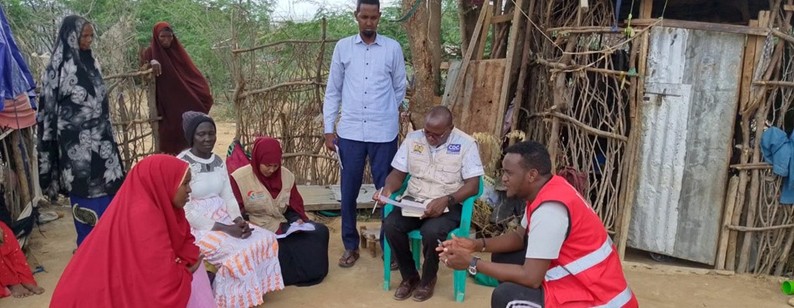
Nine days after the children arrived, Hawa Aden, a trained Care Group Mother conducting routine household visits, noticed unfamiliar children in the household.
Because of her training in identifying zero-dose children (children who have never received routine vaccinations), she immediately raised concern.
“I found out that four children had never received any vaccines. They were completely zero-dose. I immediately alerted the community mobilizer,” Hawa explained.
Community Mobilizer Noor Muhumed verified the situation and issued referral slips to ensure the children could access health services without documentation barriers.
Rapid Health System Response
The children were quickly referred to a nearby health facility where vaccination began immediately. During routine surveillance sampling for new arrivals, a stool sample from one of the children was sent to the Kenya Medical Research Institute (KEMRI) laboratory for testing.
Initial results raised concern about a possible poliovirus case, triggering a rapid multi-agency response involving:
- Ministry of Health
- UNHCR
- Kenya Red Cross
- CORE Group Polio Project (CGPP) partners
Health teams quickly assessed and vaccinated all children in the household and collected additional samples from nearby households. Health workers also conducted surveillance reviews across multiple health facilities.
Strengthening the System
Further laboratory analysis later confirmed that the child did not carry poliovirus, bringing relief to the community. However, the alert had already achieved something important.
The response helped:
- Identify and vaccinate zero-dose children
- Strengthen disease surveillance systems
- Train health workers on surveillance gaps
- Improve coordination among health partners
Community Awareness and Preparedness
For caregivers like Nuurta, the experience was eye-opening.
“I had heard of polio before but never understood its symptoms and effects. Now I know that even a healthy child can carry the virus and transmit it to others.”
A Success in Prevention
This story highlights the power of community-based disease surveillance. Because trained community volunteers were actively monitoring households, potential risks were identified early and addressed quickly.
Even though the suspected case turned out negative, the system proved that it works.
Through strong collaboration between communities and health partners, the project continues to ensure that every child is reached with lifesaving vaccines and that outbreaks are detected before they spread.
This achievement was made possible through the support of the CORE Group Polio Project (CGPP) and the dedication of Vision Corps Initiative staff and community volunteers who continue to work tirelessly to protect children and strengthen community health systems.

All Categories
Recent Posts
Early Detection Protects Children from Polio Risk in Dadaab Refugee Complex.
Parents begin adopting positive parenting practices after life skills sessions in Habaswein.
Building Dignity Through Service and Self-Reliance.